
How Do Steroids Cause Avascular Necrosis (AVN)?

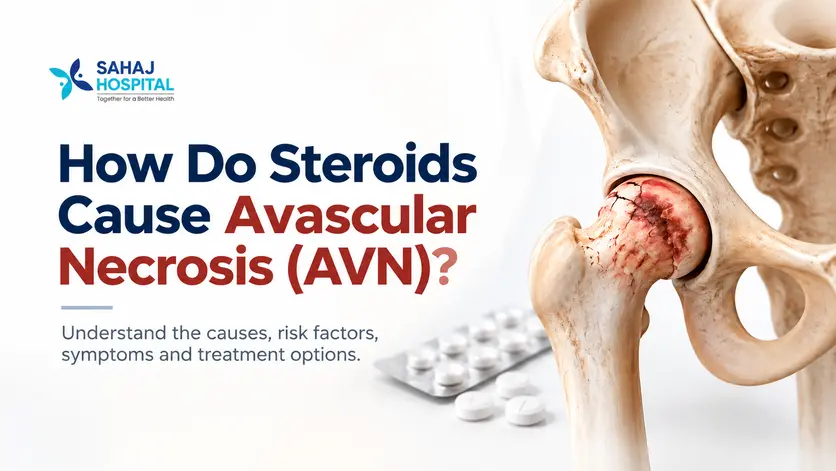
Steroids are commonly called corticosteroids or glucocorticoids. These are medicines used to treat inflammation and conditions such as autoimmune diseases. They can be very helpful when prescribed for the right reason. However, if you take high doses of these medicines for a long time it can increase the risk of avascular necrosis (AVN), especially in the hip.
AVN happens when part of a bone does not get enough blood. Without enough blood, bone cells can become damaged and die.
Steroids may affect the way the body handles fat and may also affect small blood vessels. These changes can reduce blood flow inside the bone. Researchers are still studying the exact steps that lead to steroid-related AVN.
How Can Steroids Lead to AVN?
Steroids may contribute to AVN in several related ways. They can change the way the body processes fat, affect the bone marrow, and obstruct blood flow in small vessels.
1. How Do Steroids Affect Fat Inside the Bone?
Steroids can change how the body processes fat. They may also affect fat cells inside the bone marrow. These changes may increase pressure inside the bone and make it harder for blood to move through tiny blood vessels.
2. How Can Steroids Reduce Blood Flow to the Bone?
Steroids may affect small blood vessels and the way fats move through the blood. Tiny fat particles and other changes may interfere with blood flow inside the bone. Researchers are still studying exactly how these changes contribute to AVN.
3. How Does Reduced Blood Flow Lead to AVN?
Bone cells need oxygen and nutrients from the blood to survive. When blood flow is reduced for a long time, some bone cells may die. This damage is called avascular necrosis (AVN). As the condition progresses, the affected bone may become weak and collapse.
How Much Steroid Use Can Increase the Risk of AVN?
There is no single steroid dose that will cause AVN in everyone, and no dose can be considered completely safe for every person. The risk may be higher with large doses or long periods of treatment.
Doctors may consider several details about steroid use:
Daily dose: How much steroid medicine a person takes each day.
Length of treatment: How long the person takes the medicine.
Total amount taken: The amount of steroid medicine taken over the full course of treatment.
High-dose treatment: A period when a person receives a large amount of steroid medicine.
Medicines such as prednisone, prednisolone, dexamethasone and methylprednisolone have been linked to osteonecrosis. However, the dose alone cannot tell whether someone will develop AVN. The risk differs from person to person.
Do not lower your dose or stop prescribed steroids on your own. Speak with your doctor before making any changes.
What Is the Link Between COVID-19, Steroids, and AVN?
During the COVID-19 pandemic, doctors used steroid medicines such as dexamethasone to treat some people with severe COVID-19.
Afterwards, AVN was reported in some people who had received steroid treatment. Because steroids are a known risk factor for AVN, a person’s history of steroid use may be important when a doctor looks into the cause of hip pain.
Researchers have also studied whether COVID-19 may affect blood vessels or blood clotting. However, the exact role of COVID-19 and steroid treatment in each case is not fully clear.
Not everyone who received steroid treatment developed AVN. If you have ongoing hip or groin pain after COVID-19, especially after taking steroids, you should consult a doctor.
What Are the Early Signs of Steroid-Related AVN?
AVN in the hip may cause:
- Pain in the hip or groin
- Pain while walking or putting weight on the leg
- Stiffness in the hip
- Difficulty moving the hip normally
Some people have few or no symptoms in the early stages. If hip or groin pain continues without a clear reason, especially after steroid treatment, get it checked by a doctor. Do not assume it is only a muscle strain.
Can Steroid-Related AVN Be Prevented?
AVN cannot always be prevented. If you need steroids, your doctor should choose the dose and length of treatment based on the condition being treated.
Do not suddenly stop taking prescribed steroids. Stopping them suddenly can be harmful with some treatment plans. If you have risk factors for AVN or ongoing hip pain, ask your doctor whether you need further checks.
Can Steroid-Related AVN Be Treated Without Surgery?
Treatment depends on the stage of AVN, the size and location of the damaged area, the symptoms, and whether the top of the thigh bone (femoral head) has collapsed.
Some people with early-stage AVN may be suitable for treatments that aim to protect the hip joint.
Regenerative options, including stromal vascular fraction (SVF) therapy, may be discussed for selected patients. A qualified specialist should explain the available evidence, possible benefits and risks, and whether the treatment is suitable for the individual.
SVF therapy is not suitable for everyone and should not be described as a guaranteed cure. When AVN is advanced and the bone has collapsed significantly, hip replacement may be needed.
The Bottom Line
Steroids may increase the risk of AVN by changing how the body handles fat and by affecting the bone marrow and small blood vessels. These changes may reduce blood flow to parts of the bone, including the top of the thigh bone.
Taking steroids does not mean that a person will definitely develop AVN. If you have used high doses of steroids or taken them for a long time and you have ongoing hip or groin pain, speak with a doctor. Finding AVN early may leave more treatment options.
Frequently Asked Questions
Yes. Steroid use is a known risk factor for AVN, but not everyone who takes steroids develops it.
AVN has been reported after different patterns of steroid use. A short course does not mean AVN will happen, but the risk cannot be judged by duration alone. Your doctor can assess your situation based on your treatment and medical history.
Yes. AVN may be diagnosed after a person has finished steroid treatment. Tell your doctor if you have taken steroids in the past and now have ongoing hip or groin pain.
Medical Disclaimer
This article is for general information only. It does not replace advice, diagnosis or treatment from a qualified healthcare professional. Speak with a doctor about ongoing hip pain or questions about steroid use.