
How Fast Does Avascular Necrosis Progress? What You Should Know


Unfortunately, there’s no single answer. AVN doesn’t progress at the same speed in everyone. Some people live with early AVN for years without significant changes, while others experience faster progression that may eventually lead to bone collapse.
The good news is that progression isn’t completely random. Doctors look at several factors that help estimate how likely AVN is to worsen and how closely it should be monitored.
In this article, we’ll explain what affects the speed of AVN progression, the warning signs to watch for, and why early diagnosis can make a meaningful difference.
Why Doesn’t AVN Progress at the Same Speed for Everyone?
Think of AVN as damage caused by a reduced blood supply.
Once the blood flow decreases, the affected bone gradually becomes weaker. However, the body doesn’t respond the same way in every patient.
Some people develop only a small area of bone damage that remains relatively stable. Others have a larger affected area that weakens more quickly under everyday activities like standing and walking.
That’s why two people diagnosed on the same day can have very different outcomes a year later.
Instead of predicting an exact timeline, orthopedic specialists evaluate several risk factors that influence disease progression.
What Factors Can Make Avascular Necrosis Progress Faster?
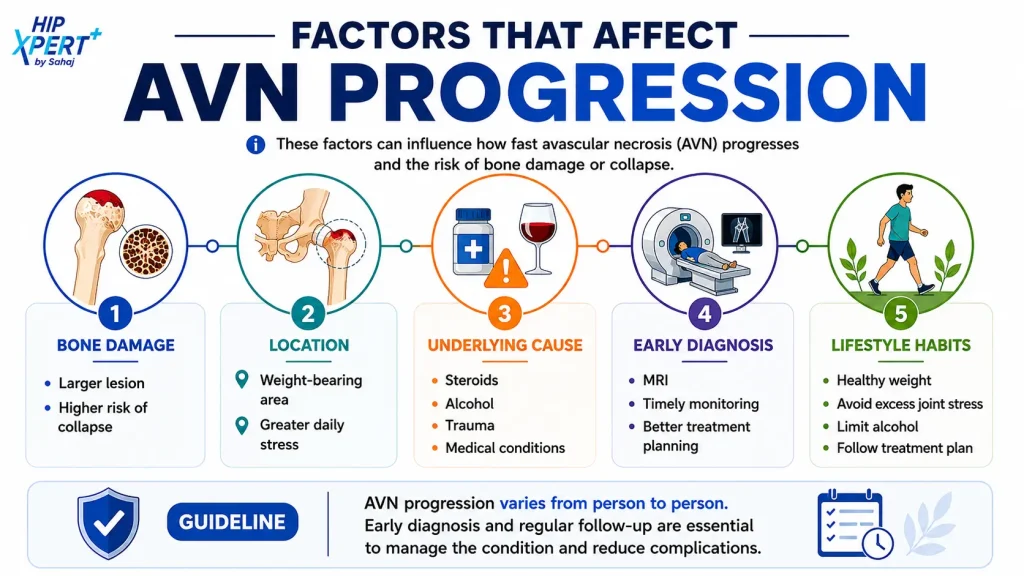
1. The Amount of Bone Damage
One of the strongest predictors of progression is how much bone has lost its blood supply.
A small lesion may remain stable for much longer, while a larger lesion weakens the bone’s structure and increases the chance of collapse.
MRI scans help doctors estimate the size of the affected area more accurately than standard X-rays.
2. Where the Damage Is Located
Location matters just as much as size.
The upper part of the femoral head supports much of your body weight whenever you stand, walk, or climb stairs.
If AVN develops in this weight-bearing area, the weakened bone experiences greater stress every day, increasing the likelihood of progression.
3. The Underlying Cause
AVN isn’t caused by one single condition.
It may develop after:
- Long-term corticosteroid use
- Excessive alcohol consumption
- Hip fractures or dislocations
- Sickle cell disease
- Certain autoimmune disorders
- Unknown (idiopathic) causes
In some situations, continuing exposure to the underlying risk factor may contribute to ongoing bone damage.
4. Delayed Diagnosis
AVN often begins with mild symptoms that people mistake for a muscle strain or simple hip pain.
Because of this, some patients aren’t diagnosed until significant bone damage has already occurred.
The earlier AVN is identified, the easier it is to monitor the disease and discuss treatment options before structural changes develop.
Can AVN Get Worse Within a Few Months?
It can, but this doesn’t happen to everyone.
More rapid progression is usually associated with larger lesions, damage in weight-bearing areas of the hip, or continued exposure to risk factors such as high-dose steroid use.
Rather than focusing on a specific number of months, doctors monitor whether imaging shows changes compared to previous scans.
This approach provides a much clearer picture of progression than symptoms alone.
This is why comparing your AVN with someone else’s experience can be misleading.
Does More Pain Mean AVN Is Progressing?
Not always.
This is one of the biggest misconceptions about AVN.
Some patients experience significant pain even when imaging shows relatively early disease. Others have surprisingly little discomfort despite more advanced changes.
Pain can also fluctuate because of inflammation, activity level, or other hip conditions.
That’s why orthopedic specialists don’t rely on symptoms alone. MRI and X-ray findings provide a much more accurate assessment of whether AVN is progressing.
What Increases the Risk of Bone Collapse?
When people ask how fast AVN progresses, they’re usually worried about bone collapse.
Collapse occurs when the weakened bone can no longer support the smooth, rounded surface of the joint.
The risk tends to increase when:
- A larger portion of the femoral head is affected
- The damaged area is located in a weight-bearing region
- Diagnosis is delayed
- The disease continues to progress without appropriate monitoring
Once collapse occurs, the joint becomes less stable, and the risk of arthritis increases significantly.
Not every patient with AVN experiences bone collapse at the same stage or rate, but the risk generally increases as the disease progresses.
Signs That Your AVN May Be Getting Worse
Symptoms alone can’t confirm disease progression, but certain changes should prompt a medical review.
Watch for signs such as:
- Hip or groin pain becoming more frequent
- Pain during shorter walks than before
- A noticeable limp
- Reduced hip movement
- Difficulty climbing stairs
- Pain that begins even while resting
If you notice these changes, it’s important to consult your orthopedic specialist rather than assuming they’re a normal part of recovery.
How Do Doctors Monitor AVN Progression?
Monitoring AVN isn’t just about asking whether the pain has increased.
Doctors usually combine several pieces of information, including:
- Your current symptoms
- Physical examination
- Follow-up X-rays
- MRI scans when needed
- Changes compared with previous imaging
This helps determine whether the disease is stable or progressing and whether the treatment plan should be adjusted.
Can Early Treatment Slow Disease Progression?
While no treatment can guarantee that AVN won’t progress, early diagnosis provides the best opportunity to manage the condition before significant structural damage occurs.
Depending on your individual case, your orthopedic specialist may recommend:
- Activity modification
- Weight management
- Physical therapy
- Pain management
- Regular follow-up imaging
- Joint-preserving procedures for suitable patients
The goal is to preserve the natural joint whenever possible and delay further damage.
When Should You See an Orthopedic Specialist?
You shouldn’t wait until the pain becomes severe.
Consider seeking medical advice if you have:
- Persistent hip or groin pain
- Pain that worsens while walking
- A history of steroid use or heavy alcohol consumption
- Previous hip trauma followed by ongoing pain
- Imaging that suggests possible AVN
Early evaluation helps determine whether the condition is stable or requires closer monitoring.
Final Thoughts
If you’re wondering how fast avascular necrosis progresses, the most important thing to remember is that there’s no universal timeline.
Rather than comparing your condition with someone else’s, focus on the factors that matter most: early diagnosis, regular follow-up, and understanding your individual risk of progression.
If you’ve recently been diagnosed with AVN or have ongoing hip pain that isn’t improving, discussing your imaging results with an orthopedic specialist is the best way to understand how your condition may change over time.
Early diagnosis, regular monitoring, and timely treatment can make a significant difference in preserving joint function and improving long-term outcomes.
Frequently Asked Questions
AVN is generally considered progressive, but the rate of progression varies widely from person to person.
Some patients experience faster progression than others, but changes are usually confirmed through follow-up imaging rather than symptoms alone.
MRI provides valuable information about the size and location of the lesion, helping doctors estimate the likelihood of future progression.
Normal daily activities don’t necessarily worsen AVN, but your doctor may recommend modifying certain activities depending on your condition.
Not every patient experiences collapse at the same time or to the same degree. Early diagnosis and appropriate management may help preserve the joint for longer.
Yes. Some patients, especially those diagnosed early with smaller lesions, may have relatively stable disease for years. Regular follow-up and imaging are still important because progression varies from person to person.